RAG Agents vs. a Standard FAQ Chatbot: How Do You Choose the Right One?
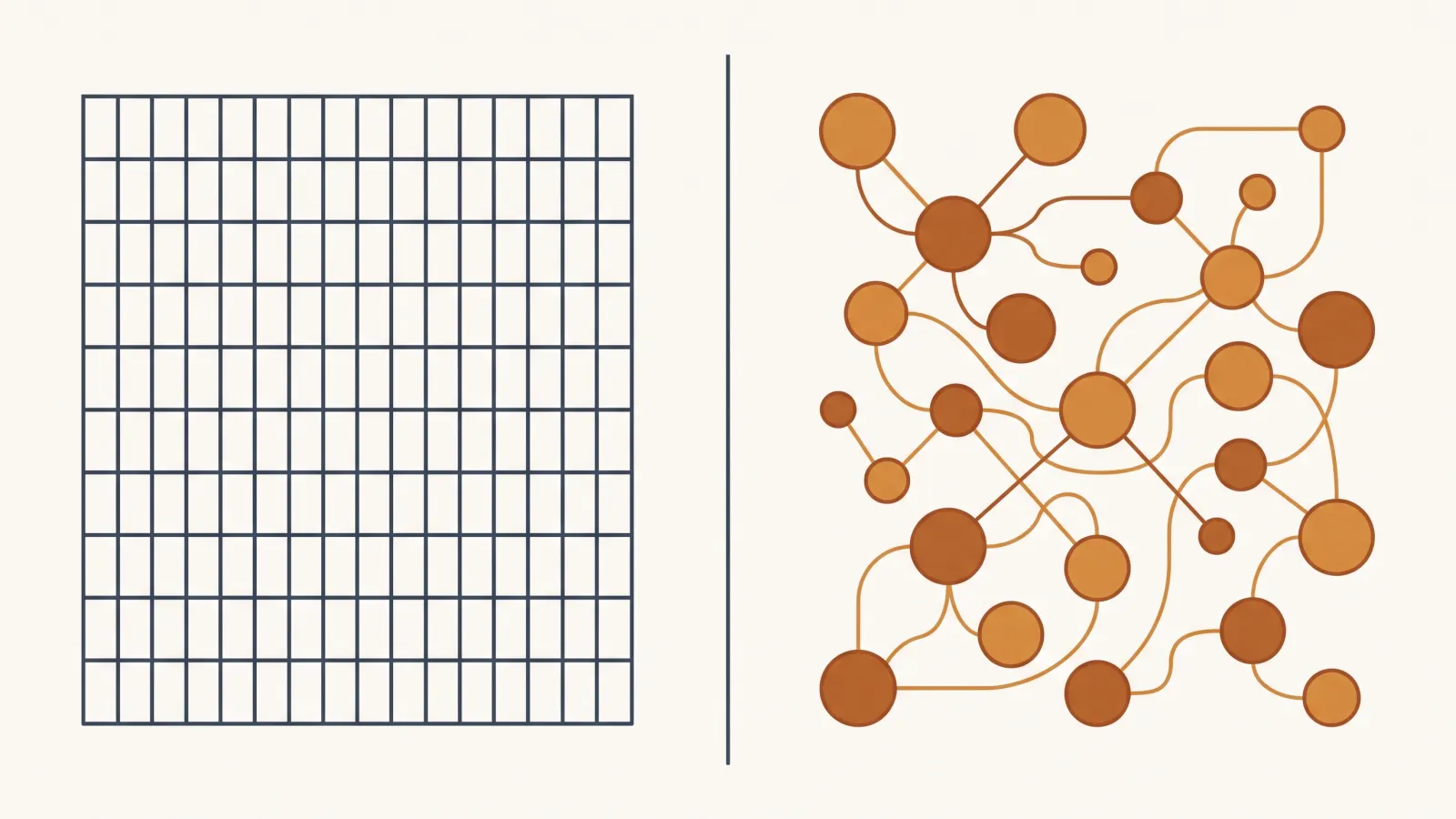
A standard FAQ chatbot matches a customer's question to a script someone wrote in advance, while a [RAG agent](/services/rag-agents) retrieves the answer from your live documents and writes a sourced response on the spot. In October 2026 there is a third option between them: AI support agents built into Intercom and Zendesk, which run retrieval over your help center and bill $0.99 to $2.00 per resolved conversation. This post prices all three, shows where each one wins, and covers the rulings that make a wrong answer your legal problem.
The Challenge
Every vendor calls its product an AI agent, so a business owner comparing options sees near-identical claims on three systems that behave nothing alike in production. A scripted FAQ bot answers the twenty questions you gave it and nothing else. Intercom Fin and Zendesk AI agents answer from your help center and charge per resolution, so the bill grows with your volume. A custom [RAG agent](/services/rag-agents) costs more up front, searches documents a help center cannot hold, and leaves you in control of what it refuses to answer. Pick on price alone or on a demo, and you pay twice: once for the wrong system and again for the one you needed first.
What You Will Learn
A scripted FAQ bot matches questions to pre-written answers; a RAG agent retrieves your documents and generates new answers with citations.
Intercom Fin bills $0.99 per outcome and Zendesk AI agents bill $1.50 to $2.00 per resolution beyond a small plan allowance, so the bill grows with the agent's success.
A custom RAG agent earns its $8K to $15K cost when answers live outside a help center, users are staff, volume is high, or you need control over refusals, citations, and data location.
Air Canada (2024), Cursor (2025), and the Aesthetify ruling in Germany (2026) all land the cost of a wrong chatbot answer on the business, so label the bot and keep logs.
Use the six-question test on volume, change frequency, where answers live, who asks, cost of a wrong answer, and twelve-month meter cost.
Follow Along
What each system does under the hood
A scripted FAQ bot runs on decision trees or keyword matching. A customer types a phrase, the bot finds the closest pre-written answer, and returns it word for word. Nothing gets generated.
A RAG agent searches your documents for the passages relevant to the question, then writes a new answer from what it found, with a citation back to the source. One retrieves a fixed answer. The other retrieves raw material and writes.
The vendor AI agents (Intercom Fin, Zendesk AI agents) are RAG agents too, with two constraints. The vendor controls the retrieval pipeline, and the knowledge sources are the ones the vendor supports, which in both cases centers on your help center plus connected files. Zendesk lists Google Drive and PDFs as external sources. Intercom lists third-party systems reached through APIs, data connectors, or MCP for actions like order lookups and refunds. If your answers live in a help center and a handful of connected tools, these products cover most of what a custom build did in 2024.
What off-the-shelf support agents do and cost in October 2026
List prices from the vendors' own pricing pages this week:
Intercom Fin. $0.99 per outcome. A resolution counts when no further help is requested after Fin's last answer. Conversations Fin hands to your team with no outcome are free. Lead qualifications bill at $9.99 each. On Intercom's own helpdesk, seats start at $29 per month. Fin also runs on Salesforce, HubSpot, Freshworks, Zoho, Gorgias, and others with no seat cost, with a 50-outcome monthly minimum. Copilot for human agents is $35 per user per month. Intercom reports an average resolution rate of 76 percent across 12,000+ customers, which is a vendor figure, not an audit.
Zendesk AI agents. Included in every Suite and Support plan, billed on successful outcomes. Suite Team is $55 per agent per month billed yearly and includes 5 automated resolutions per agent per month. Suite Professional is $115 and includes 10. Beyond the allowance, committed resolutions cost $1.50 and pay-as-you-go resolutions cost $2.00. Copilot is $50 per agent per month on Professional and above. Zendesk's own help article defines a billable resolution as one the AI handled without escalation, verified by an LLM, counted 2 hours after the first message on messaging and 72 hours after the first email.
Worked example. Say you handle 1,000 support conversations a month and the agent resolves 70 percent, so 700 resolutions. On Fin that is $693 in outcome fees plus seats. On Zendesk Suite Team with three agents, you pay $165 for seats, get 15 resolutions included, and pay $1,027.50 for the remaining 685 at the committed rate, so about $1,193 a month. Both meters have the same property: the better the agent performs, the bigger the bill. Budget on resolutions, not conversations.
Where a scripted bot still wins
For ten to twenty stable questions (store hours, return policy, shipping cost), a scripted bot is cheap, launches in a week or two, and is hard to get wrong, because a human wrote every word in advance. A wrong answer is impossible unless a human typed it. If your support volume stays low and your answers rarely change, a per-resolution meter and a retrieval pipeline both add more than the problem needs.
Where a scripted bot breaks
The moment a customer phrases a question a way nobody scripted for, the bot returns the closest generic match or admits it cannot help. Businesses with large or changing document libraries (product catalogs, policy manuals, technical documentation) hit this wall every week. Every new product, policy change, or edge case means another manual script update, and the backlog of unscripted questions grows faster than your team writes for it. Vendor AI agents fixed this for the help-center case. The next section covers the cases they did not fix.
When a custom RAG agent still earns its cost
A custom build at JY Labs falls in the Build Sprint tier, $8K to $15K one time, with optional retention at $499 to $999 a month. A typical deployment runs six to seven weeks, with a working prototype by week three. Against the Zendesk example above, that is about one year of the meter at 1,000 conversations a month. The custom build wins in five situations:
- Your answers do not live in a help center. Contracts, scanned PDFs, an ERP, a ticket archive, a shared drive with 50,000 files. A regional law firm put 50,000+ contracts, briefs, and case files behind a RAG agent and cut attorney research time by 80 percent, from 3.2 hours to 38 minutes a day. No support-desk product indexes that corpus.
- The users are your staff, not your customers. Per-resolution pricing assumes a support ticket. An internal knowledge agent for onboarding, policy lookups, or sales enablement has no ticket to meter.
- You need control over what the agent refuses. In a custom build you set the confidence threshold below which the agent says it does not know and hands off. You choose the citation format, down to the paragraph. The law firm build tested 200+ real attorney questions against expert-verified answers and tuned until accuracy exceeded 95 percent. Vendors publish a resolution rate. They do not publish your accuracy on your questions.
- Volume is high enough that the meter hurts. At 3,000 conversations a month and a 70 percent resolution rate, the Zendesk example runs about $3,100 a month in resolution fees alone. A custom build swaps that for model usage and hosting, which you pay per token rather than per outcome.
- Data has to stay where you put it. Regulated data, client confidentiality, or a contract that forbids a third-party processor. You choose the model, the region, and the logs.
If none of the five applies and your knowledge already sits in a help center, buy the vendor agent. The AI ROI calculator will show you where the meter and a one-time build cross for your volume.
A wrong answer is your liability, whichever system you pick
Three cases to know before you sign anything:
Moffatt v. Air Canada, February 14, 2024. Air Canada's website chatbot told a grieving customer he could apply for a bereavement fare after travel. The airline's own policy page said the opposite. Air Canada argued the chatbot was a separate legal entity responsible for its own statements. The British Columbia Civil Resolution Tribunal called that a remarkable submission, held Air Canada responsible for all the information on its website, and ordered CAD 812.02 in damages, interest, and fees. The amount is small. The principle travels.
Cursor, April 2025. A front-line AI support bot named Sam told a customer the product was designed to work on one device per subscription as a security feature. No such policy existed. The company apologized on Reddit and Hacker News, refunded affected users, and now labels AI-generated support replies. Cost: cancellations and public criticism on Hacker News and Reddit for a company whose product is AI.
Aesthetify, OLG Hamm, May 12, 2026. A German cosmetic clinic's chatbot told prospective patients its two founders held specialist surgical titles they did not hold. The Higher Regional Court of Hamm ruled the statements were misleading commercial practice attributable to the company, and said the company would be responsible even if it had programmed the chatbot only with correct data. The court allowed an appeal to Germany's Federal Court of Justice, so the ruling is not final.
What this means for the choice. A scripted bot has the lowest hallucination risk because every answer was pre-approved. A vendor agent is grounded on your help center, and the output is still yours under the rulings above, so read the contract for who carries the liability. A custom RAG agent lets you set the refusal threshold, require a citation on every answer, and log every exchange, which is the evidence you want when a customer disputes what the bot said. Whichever you pick, label it as AI. Maine, New Jersey, and California have bot disclosure statutes, and if you sell into the EU, Article 50 of the AI Act has required chatbots to disclose they are AI since August 2, 2026.
Cost and setup time, side by side
Scripted FAQ bot. One to two weeks. Platform fee only. Zero hallucination risk, zero coverage outside the script.
Vendor AI agent (Fin, Zendesk). Days to a few weeks, since the vendor already has your help center. $0.99 to $2.00 per resolved conversation plus seats. Coverage limited to supported sources. Bill rises with volume and with the agent's success.
Custom RAG agent. Six to seven weeks, prototype by week three. $8K to $15K one time plus hosting and model usage. Indexes anything you can export. You own retrieval quality, refusals, citations, and logs.
A six-question decision framework
Ask six questions before choosing.
- How many distinct question types does your team field in a month: under twenty, or hundreds?
- How often do your answers change: rarely, or every product launch?
- Where do the answers live: a help center, or contracts, PDFs, and internal systems?
- Who asks: customers through a support channel, or your own staff?
- What does a wrong answer cost: an extra email, a lost sale, or a compliance violation?
- At your volume, what does the per-resolution meter cost over twelve months?
Under twenty stable questions: scripted bot. Hundreds of questions, answers in a help center, customers asking, moderate volume: vendor AI agent. Answers outside a help center, internal users, high cost per wrong answer, or a meter above the one-time build within a year: custom RAG agent. Two systems side by side is a legitimate answer. Keep the scripted bot for the handful of answers legal has to approve word for word.
If you want a second opinion on your numbers, JY Labs runs a paid $350 AI strategy session, credited in full toward a build. Book it here.
Outcome & Impact
You now have a working test for the FAQ bot, vendor agent, and custom RAG decision instead of a sales pitch. Count your monthly conversations, estimate the resolution rate, and multiply by $0.99 to $2.00 to see the meter. If the twelve-month meter exceeds a one-time build, or your answers live outside a help center, a custom RAG agent pays back within the year. If you have twenty stable questions, a scripted bot solves the problem for a fraction of either.
Get AI Insights Delivered
Join our newsletter for case studies, tutorials, and automation strategies.
Additional Benefits
Signs you have outgrown a scripted bot
Your support team edits the script more than once a month, customers get 'I don't understand that' responses every week, or new hires still get pulled into answering questions the bot should handle. Any of these points to a knowledge base your scripted answers cannot keep pace with.
When businesses run two systems
Some companies keep a scripted bot for the handful of high-stakes answers (refund policy, safety information) where legal signed off on exact wording, and run a [RAG agent](/services/rag-agents) for everything else. The split works when compliance review requires fixed text on specific topics and the agent handles the long tail.
Questions to ask a vendor before you sign
Ask what the agent does when it cannot find a confident answer. Ask whether every response includes a source citation. Ask what counts as a billable resolution and how it is verified. Ask how the vendor measures accuracy on your questions rather than a generic benchmark. Ask who carries the liability for a wrong answer in the contract. A vendor who cannot answer these is selling a scripted bot with a RAG-shaped marketing page.
Ready to Transform Your Business with JY Labs?
We help businesses and founders turn AI ideas into reality: fast, secure, and production-ready. From chatbots to custom automation, our team delivers results you can trust.
Never Miss a Tutorial
Get the latest AI automation insights and case studies delivered to your inbox.
You Might Also Like
What Are RAG Agents? A Plain-English Guide for Business Owners
RAG agents (Retrieval-Augmented Generation) are AI assistants that search your company's own...
Fractional AI Operator vs. an In-House AI Hire: How Do You Choose?
Choose a fractional AI operator over an in-house AI hire when you have ongoing AI work but less than...

AI Automation for Financial Services: Where Advisors and Community Banks Should Start
AI automation for financial advisors and community banks should start with meeting notes, then...